
Van Buren Parole and Probation
Parole and probation both allow a person to live in the community under rules, but they begin in different ways. The Tennessee Board of Parole may grant parole before a prison sentence ends. A grant alone does not open the prison gate. Tennessee Department of Correction, or TDOC, guidance says required pre-release conditions and an approved release plan can still stand between the decision and physical release. TDOC then provides community supervision. Probation is imposed by a court. It may replace incarceration, follow a jail term, or form part of another sentence set by law.
The distinction matters in Van Buren County. A sheriff release card proves that the person left Van Buren County Jail at the displayed time. It does not identify a supervision order. A court judgment may establish probation, while FOIL may show a probation or parole status for a felony offender in TDOC's system. A person can also complete jail custody with no state supervision. Read the court, jail, and TDOC records as separate parts of the same history.
| Point | Parole | Probation |
|---|---|---|
| Who orders it | Tennessee Board of Parole | Sentencing court |
| When it begins | Before sentence expiration, after approval and release steps | As directed in the judgment, with or without a custody term |
| Public starting source | FOIL status and Board records | Court judgment and FOIL when TDOC supervises |
| Who supervises | TDOC community supervision | TDOC when the order is within its supervision role |
| How it ends | Discharge, sentence expiration, or other official action | Completion or discharge under the court and supervising authority |
Determinate release is another Tennessee term. It applies only when the statute and sentence qualify. TDOC describes a limited route for certain felony sentences, not a rule for every released person. Never infer it from sentence length alone.
Verify Van Buren Post-Release Supervision
The official public starting point is TDOC's Felony Offender Information Lookup information page. FOIL covers people currently or formerly in TDOC custody or under TDOC supervision. Its records may show status terms such as incarcerated, parole, probation, or inactive, plus location, sentence, hearing, and release information. Not every record has every field. Identity must come before status because common names and aliases can produce more than one result.
- Open the official FOIL page and follow its search link. Search by name, TDOC ID, or state ID when available.
- Complete the case-sensitive CAPTCHA. Compare the name, age or birth detail, photograph, TDOC number, and offense information.
- Read the exact status. “Parole,” “probation,” “inactive,” and “incarcerated” are not interchangeable.
- Note the location or supervising office shown. Call the field office before travel and use the TDOC number for a clear match.
- Check the court judgment when probation terms or the source of the order matters. Use Board records for a parole decision.
- For older material, use the TDOC archived-record request with full identity details.
FOIL is broader than the county jail roster. The jail roster tracks present local custody, while FOIL can retain a former TDOC relationship. Still, an “inactive” result should be read narrowly. It may be consistent with a closed TDOC case, but the release record, archived file, court order, or formal discharge is stronger proof. For the county jail's own release event, use the Van Buren County released-inmate search path and request the disposition if the destination matters.
Note: FOIL result labels vary by person, so record the words actually shown instead of assuming a universal discharge label.
Van Buren Supervision Office Routing
Van Buren County does not have a separately listed TDOC supervision office in Spencer. The state field directory assigns Van Buren and Warren counties to a shared office in McMinnville. District 31 is administered from Cookeville. This rural routing detail can save a needless trip. A person released to supervision should verify the assigned reporting location because a record may point to a district function, a field office, or a different office after an approved move.
Van Buren/Warren TDOC Office
Community Supervision
102 Mullican Street
McMinnville, TN 37110
Phone: 931-473-7213
Fax: 931-473-8206
No public office hours were established in the research. Call before visiting.
The TDOC community-supervision field directory is the source for the current assignment and contact details. Its Van Buren/Warren row is shown below. The image helps confirm why a Spencer address should not be guessed.
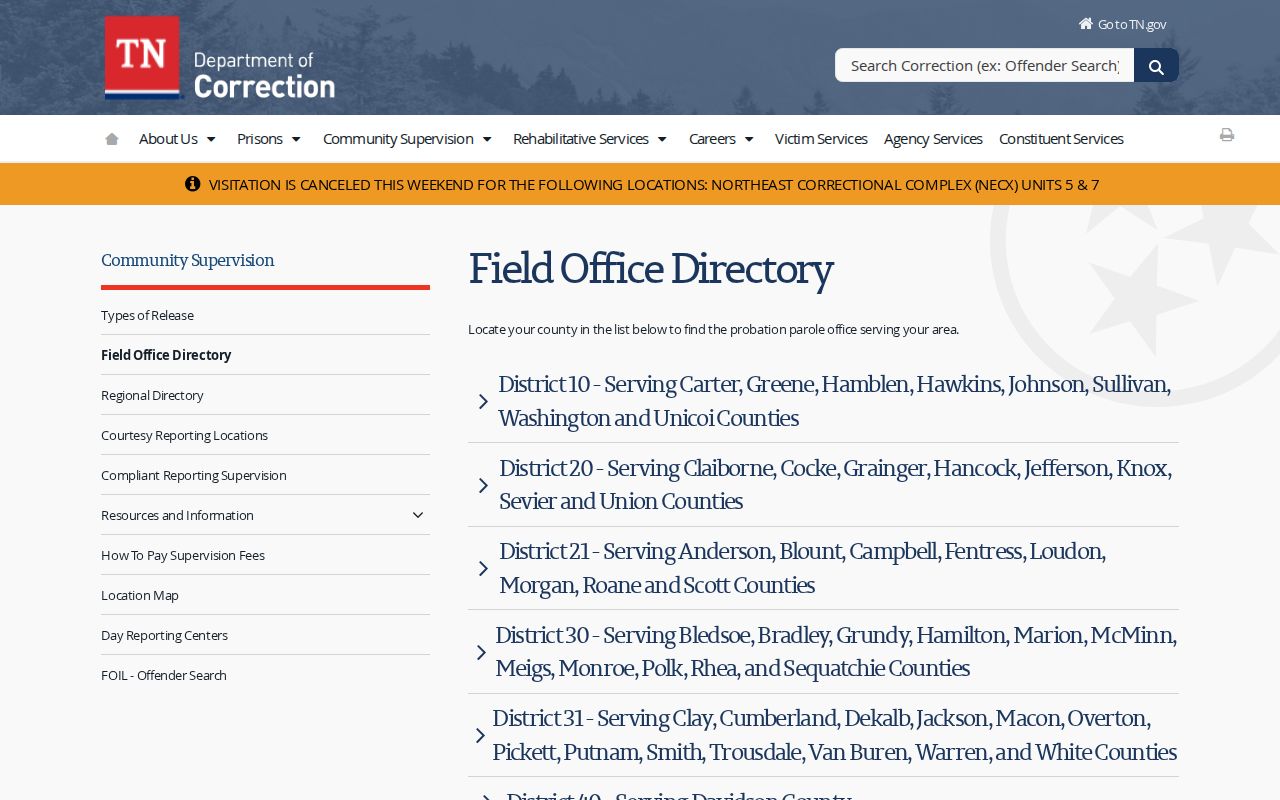
The listing supports calling McMinnville first while recognizing that TDOC can route a case through District 31 or another approved location.
Van Buren Parole Hearing Records
A hearing schedule is not a release schedule. The Tennessee Board of Parole conducts hearings for eligible offenders in prisons, county jails, and other sites. Hearing officers make recommendations, while Board members make final decisions under the required voting rules. The Board can grant, deny, or defer parole. It can also consider revocation, rescission, and appeal matters. Even a grant may require an approved release plan before TDOC carries out the release.
The Board says prison and county-jail hearing schedules are updated each week, normally on Monday or Tuesday after a Monday holiday. Current instructions direct requests to BD.HearingSchedules@tn.gov. Specify Van Buren County Jail and include the person's TDOC ID when known. The official parole hearing schedule page documents that request route.

The schedule can confirm that a proceeding is planned. FOIL, the Board's final outcome, TDOC release record, and the supervision office form the stronger chain for deciding what happened next.
No separate public searchable Board decision database was verified. An institutional probation or parole officer, the Board, or a public-records request may supply the result. Words matter here. “Recommended,” “scheduled,” “deferred,” and “granted with conditions” do not prove that the person left custody.
Van Buren Violations and Discharge
Supervision carries conditions set by the Board, court, and TDOC. A violation allegation can lead to review, added controls, arrest, or revocation proceedings, depending on the order and facts. An absconder is a person alleged to have stopped reporting or otherwise left authorized supervision. That label does not mean supervision ended. A warrant also signals unresolved legal process, not discharge.
No official Van Buren Sheriff absconder or warrant list was found. Social posts and private wanted pages are not a complete substitute. Check FOIL, ask TDOC about office assignment and status within lawful limits, consult the court record, and use the Board process for a parole matter. VINE can report certain custody changes, but it does not replace the supervision file or warrant source.
- Parole
- Conditional community release granted before sentence expiration by the Board of Parole.
- Probation
- A court-ordered community sentence or supervision period.
- Absconder
- A person alleged to be outside the terms of active supervision, often due to failure to report.
- Revocation
- An official process that may withdraw community release after a violation finding.
- Discharge
- Formal completion or termination of the relevant supervision obligation.
Discharge needs its own record. Mandatory reentry supervision can also cause physical release, sentence expiration, and the end of supervision to fall on different dates. TDOC explains that the framework applies to covered felony offenses committed on or after July 1, 2021. Eligibility, detainers, classification, and other legal conditions affect the route. A released person may therefore be outside a jail yet still subject to a valid supervision order.
Note: Confirm discharge through the supervising authority or court rather than treating an old release date as the end of every obligation.
Van Buren Supervision Decision Records
When the public status does not answer the question, request the record that made or ended supervision. For parole, that may include the Board's final disposition, certificate work after a grant, release-plan approval, revocation result, or discharge material. For probation, the court judgment, later modification, violation order, and satisfaction or discharge entry provide the legal history. A sheriff release card cannot replace either file because it records an exit from the jail, not the whole supervision order.
The Tennessee Board of Parole accepts public-records requests through its official request channel. A focused request should identify the person by full name and TDOC number, state the decision or date range sought, and ask for an existing final record rather than a new explanation. Tennessee's public-records framework generally requires enough detail for the custodian to locate the record. Prompt access is the rule, while a nonprompt response may produce the record, deny it with a legal basis, or give a reasonable production estimate within the statutory response structure.
The Board Operations overview describes how final dispositions and certificates move through the agency.
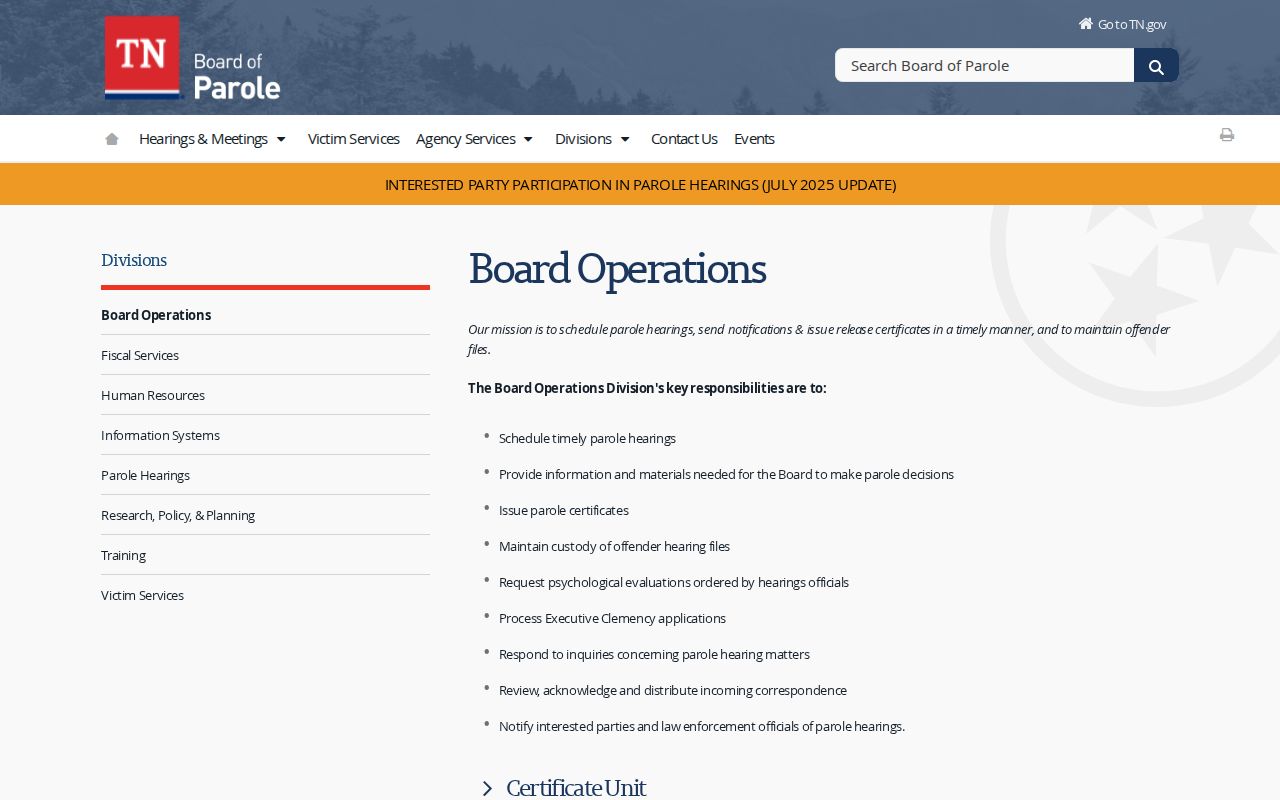
The process view reinforces why a recommendation or hearing result must be followed by the final decision and executed release record.
Board appeals are limited and are not a second routine hearing. The Board identifies significant new information, official misconduct, or significant procedural error as grounds and states a 45-day submission period after final-decision notice. That process concerns review of the parole decision. It does not itself establish a release date. The reliable sequence remains final decision, TDOC authorization and status, physical release record, then field-office confirmation when supervision begins.
Keep the county and state files distinct. Van Buren Circuit Court records explain a local probation order. TDOC and Board records explain state parole or TDOC-supervised probation. A formal discharge closes the relevant obligation, while a transfer or office reassignment merely changes who manages it.